Recipes
Know what every portion costs
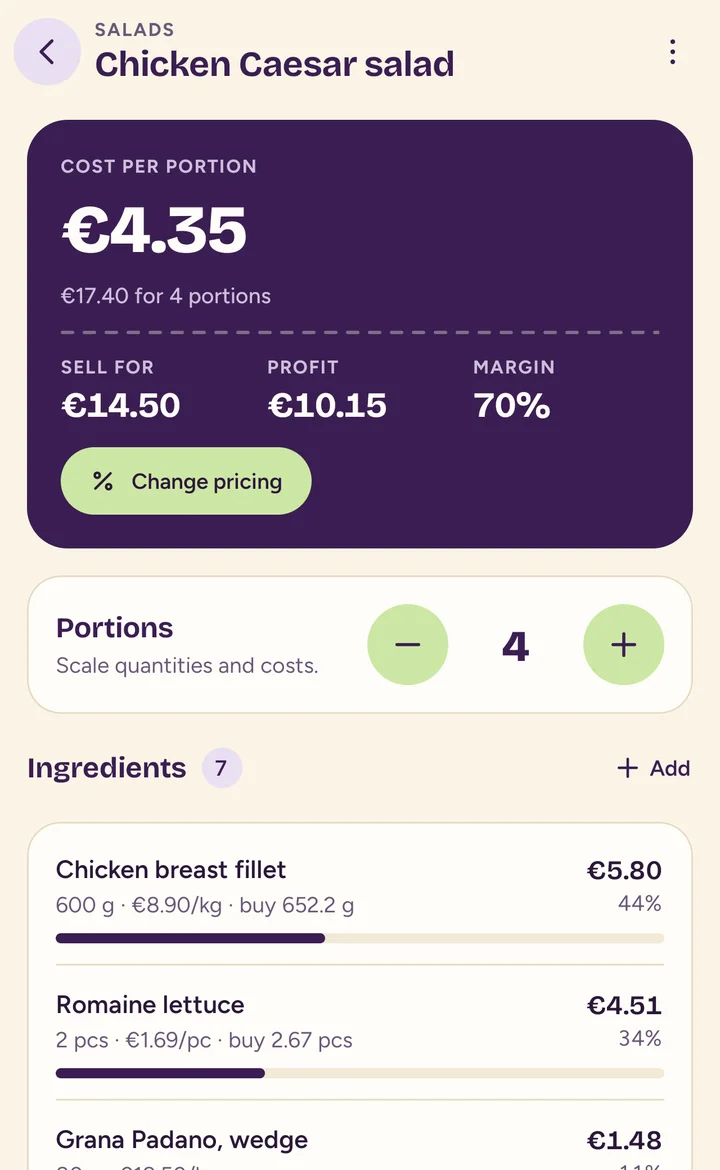
Build a dish from your catalogue. The ticket shows the cost per portion and per batch, with the selling price, profit and margin next to it.
 Betera
Coming soon
Recipe costing for small kitchens
Betera keeps your purchase prices, costs every recipe from them and turns the cost per portion into a selling price from the margin or markup you want.
The Android app is not in the store yet. This button becomes the download link on release day.
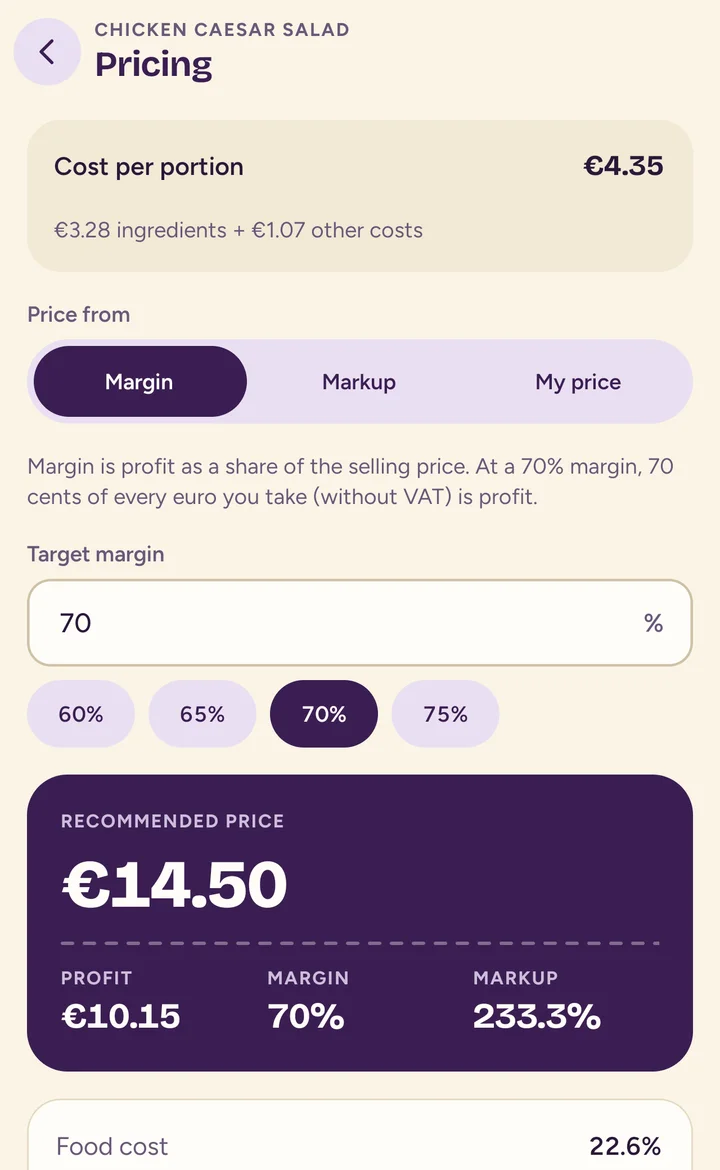
€4.35 costs one portion
€14.50 is the price at a 70% margin
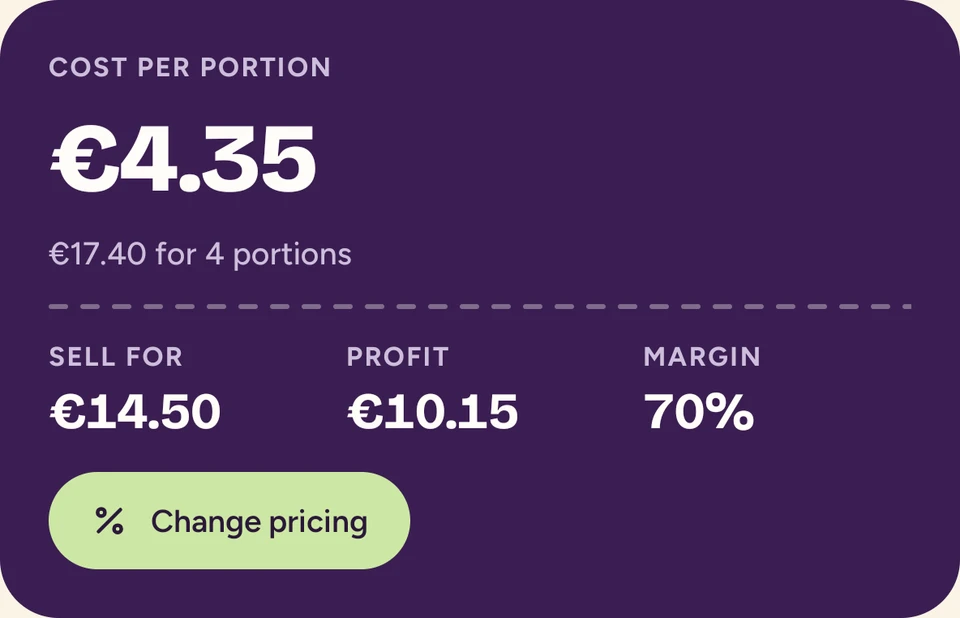
This is the chicken Caesar salad from the app's sample kitchen. The app does this arithmetic again every time a price or a recipe changes.
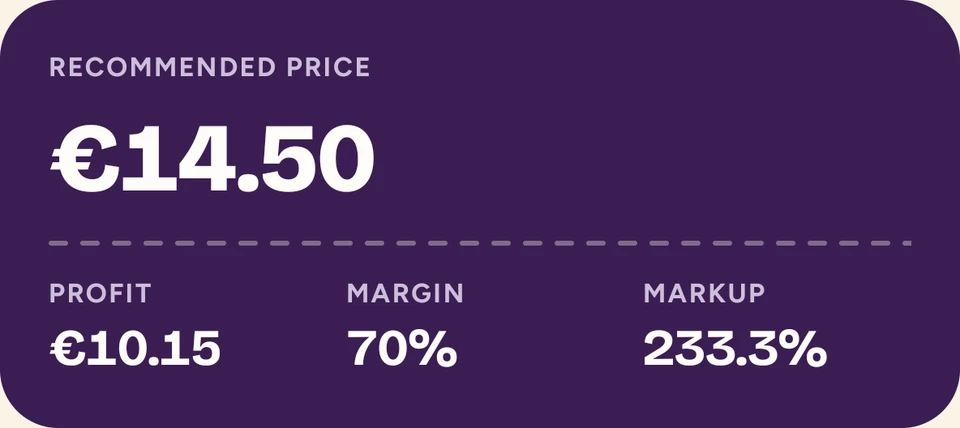
Same dish, same €14.50, same €10.15 profit. A 100% markup is only a 50% margin, so it matters which one you mean. The app accepts either and always shows both.
Profit as a share of the selling price.
€10.15 ÷ €14.50 = 70%
Profit as a share of the cost.
€10.15 ÷ €4.35 = 233.3%
Real captures from the app with its sample kitchen loaded.
Recipes
Build a dish from your catalogue. The ticket shows the cost per portion and per batch, with the selling price, profit and margin next to it.
Ingredient lines
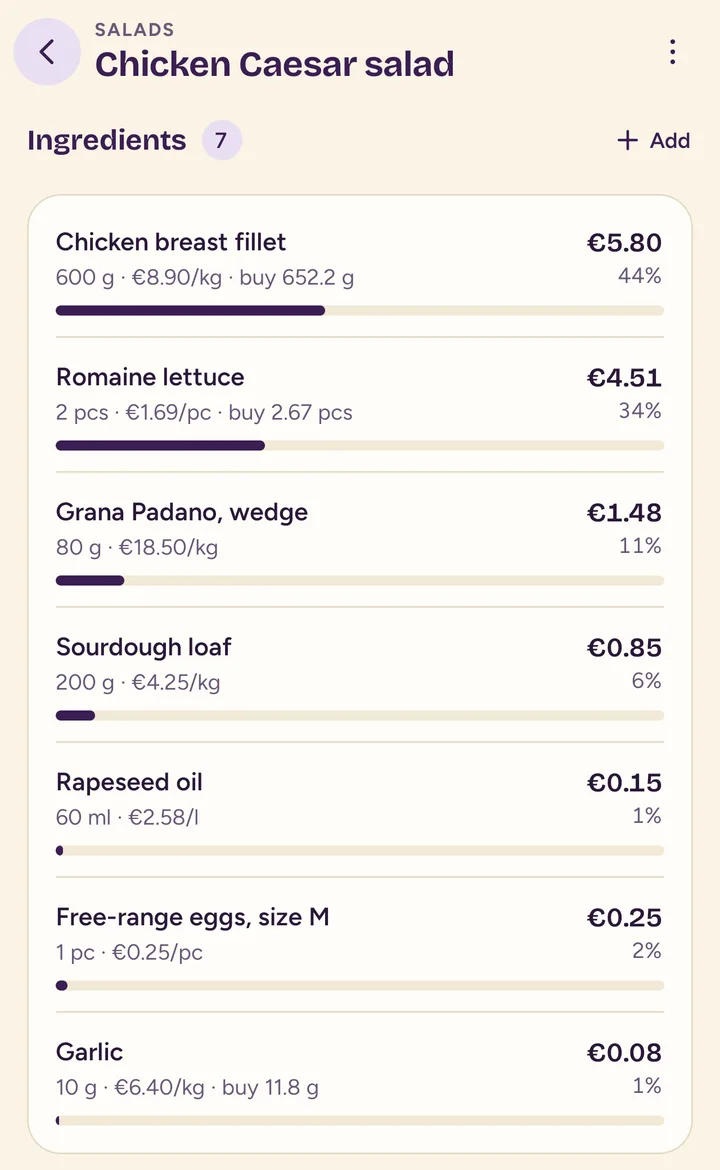
Each line has its quantity, unit price, cost and share of the dish. Where you trim or peel, it also says how much to buy: 600 g of chicken on the plate means buying 652.2 g.
Pricing
Set a target margin or a target markup, or type your own menu price. You get the price, profit, margin, markup and food cost percentage.
Price history
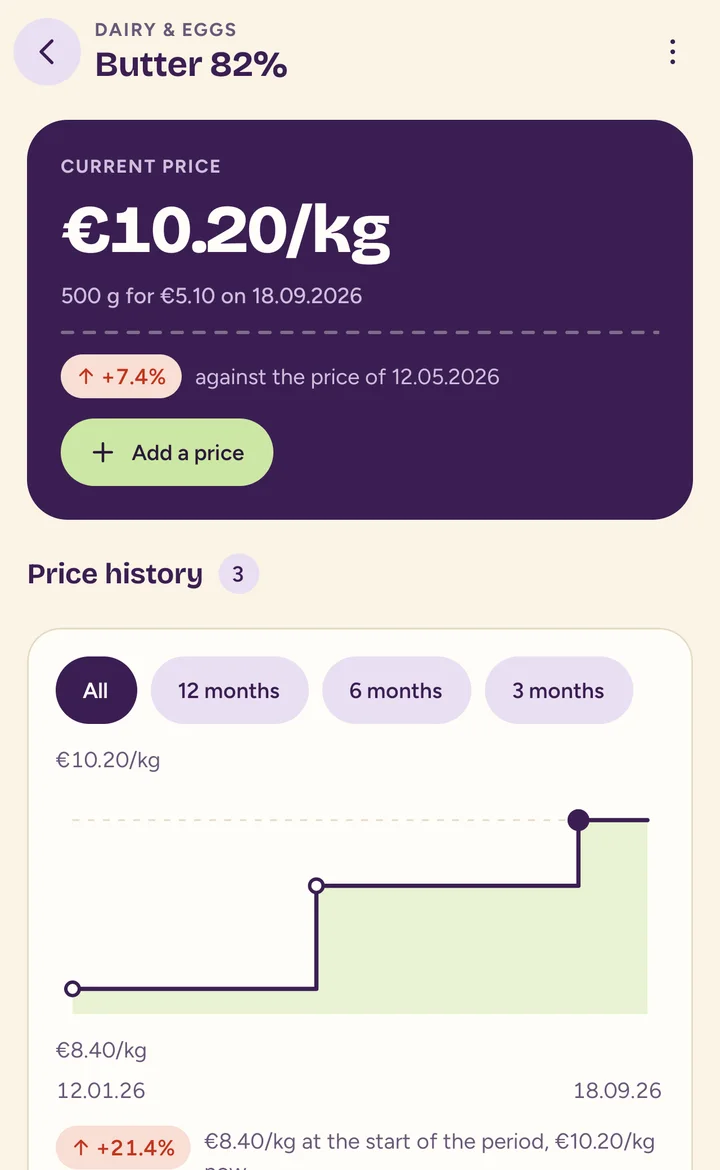
Every purchase price is kept with its date. Butter went from €8.40/kg on 12.01.2026 to €10.20/kg on 18.09.2026, up 21.4%, and every recipe that uses it was recosted.
Variants
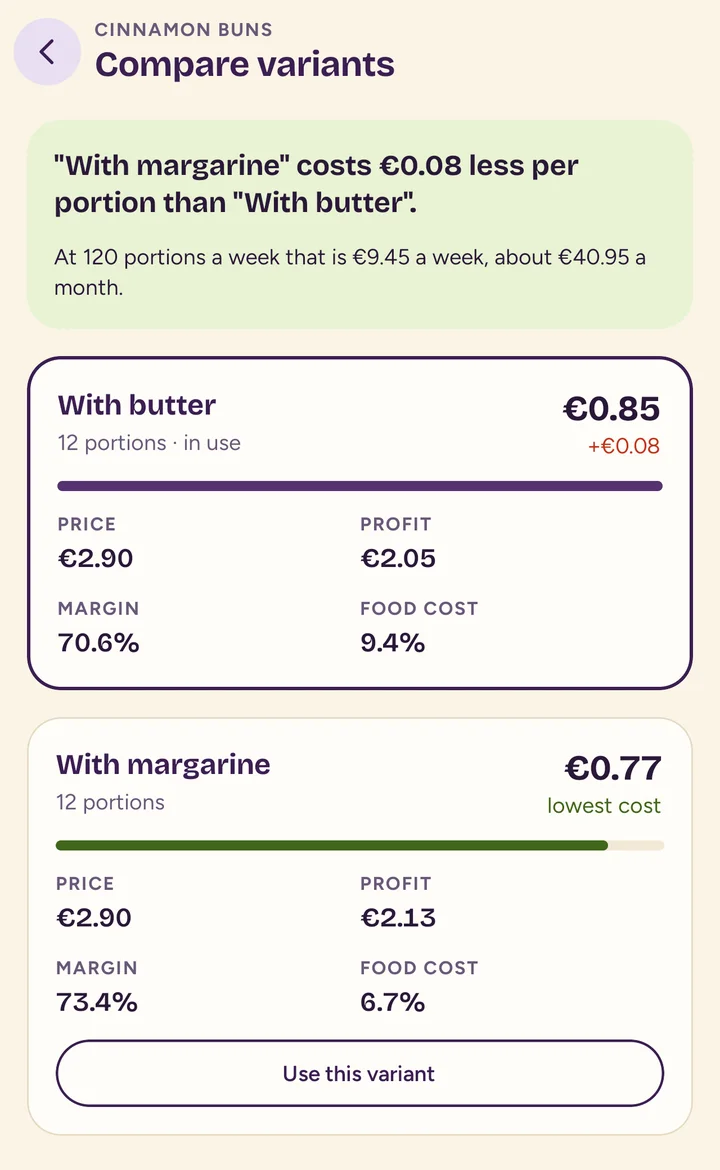
Keep variants of one recipe side by side. Here cinnamon buns cost €0.85 a portion with butter and €0.77 with margarine; at the same €2.90 price the margin moves from 70.6% to 73.4%.
Insights
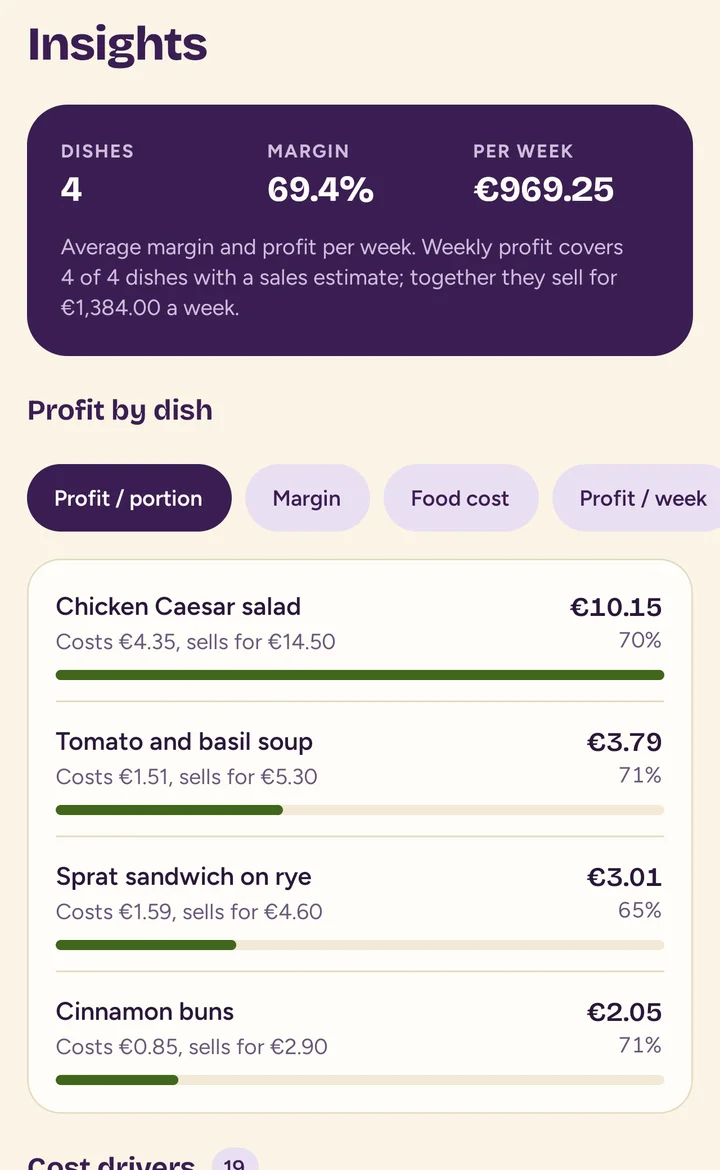
Dishes ranked by profit per portion, margin, food cost or profit per week, and the ingredients that carry the cost of the whole menu.
The examples are the ones on the app's own “How costing works” page, where every formula can be checked with a pocket calculator.
300 g ÷ 0.88 = 341 g
Peel, bones and trimmings are paid for but not served. Onions at €0.99/kg with 88% usable: 300 g in the pot means buying 341 g, which costs €0.34.
20 min × €9.00/h = €3.00
Add the costs that are not ingredients, per portion or per batch. Labour goes in as minutes at an hourly rate, energy as appliance power and running time: a 3 kW oven for 25 minutes uses 1.25 kWh, at €0.18 that is €0.23.
600 g × 10 ÷ 4 = 1.5 kg
Change the number of portions and every quantity and cost follows. A cost per batch stays one charge: labour of €3.00 is €0.75 a portion at 4 and €0.30 at 10.
€7.70 + 24% = €9.55
VAT is optional. Set your rate and the app shows the price with and without VAT. If you reclaim VAT, it is taken out of your purchase prices before costing.
then → now
Cost the same recipes with the prices of two days (30 days, 90 days, 6 or 12 months apart, or your own dates) to see what supplier price changes did to each dish.
50% … 80%
A price from a cost without a recipe, with a table of prices at margins from 50% to 80%. Nothing is saved.
Share a costing sheet for any recipe as PDF or CSV. Export the menu overview, the ingredient catalogue and the full price history. Save a backup file and restore it on this or another phone.
Cakes, meal prep, market stalls: know the cost of a portion before you name a price.
Record a supplier's new price and see which dishes on the menu it touches.
Scale a recipe to the order, read what to buy and hand over a costing sheet as PDF.
The app calculates your own costs and prices from the figures you enter. The results are your estimates. It is not accounting software and gives no accounting or tax advice.
Amounts in euros (€12.50), dates as day.month.year (20.10.2026), metric units: g, kg, ml, l and pieces. The app is in English.
Margin is the profit as a share of the selling price; markup is the profit as a share of the cost. A dish that costs €4.35 and sells for €14.50 makes €10.15: a 70% margin and a 233.3% markup. The app lets you set either as your target.
Yes, completely. The app does not use the internet at all.
VAT is switched off until you turn it on. With VAT on, you set the rate, the target margin or markup is worked out on the price without VAT, and VAT is added to get what the customer pays. You can also say whether the purchase prices you type include VAT.
Nothing is uploaded anywhere, and Android's own cloud backup is switched off for this app. Save a backup file in the app (More → Data and export) and restore it on the new phone. Without a backup file, uninstalling the app removes your data.
Yes. The app can load a sample kitchen: a small café with 20 ingredients, their price history and four dishes. It sits next to your own data and can be removed again.
Yes. Every feature is included. There are no adverts, no subscription and no in-app purchases.
No. The app works out your own estimates from the prices and quantities you enter. It does not replace bookkeeping and gives no accounting or tax advice.
Add what you buy, build the recipe, read the price.
Coming soon to Google PlayThe Android app is not in the store yet. This button becomes the download link on release day.